Tampilkan postingan dengan label rigs. Tampilkan semua postingan

Minggu, 26 Juni 2016

Different Rigs on the Same Boat

Most of my published sailing boat plans come complete with a number of different rig options.What makes mine different from most other offerings on the market is that I try to arrange the various rigs so that the original mast can be used for several different rigs, and that the original mast steps and mast partners can be used. By that I mean that a builder can choose one rig at the time of building, and at a later date, rig the boat differently by simply ordering some new sails and, maybe, making a few different yards, or gaffs etc. But no structural changes need to be made to the boat herself, and the rigs can be changed at will.

Each photo below is of Paul Hernes Phoenix III named Willy Wagtail.  Even though she is sporting a green sheer strake in the first, second and fourth photos, and is looking nicer with a more plain colour scheme in the other two, she is the same boat, and nothing has been changed other than the sailing rig.


Phoenix III with her sprit rig set without a boom. This can only be done on boats which have had the correct sheeting geometry designed-in from the beginning.

Here is the very same boat, but with a boom fitted. The boom makes the boat slightly easier to handle, and allows more options for sheet locations, but the boomless rig is more seaworthy, as there is no boom to drag in the water if the boat is over-pressed - a situation which often prevents the helmsman from being able to ease the mainsail and can lead to any boat sailing herself over into a capsise 

Showing off with her new paint job, Willy Wagtail has been rigged with the balance lug sail. The mast is the original, the mast step is original, and the mast partner is original. All Paul did was use a different sail. Some days, he starts off using the larger sprit rig (which can be sailed with or without the jib) and changes to the smaller balance lugsail if the wind comes up, or if he starts to feel lazy.

This shows the boat sailing under mainsail alone


In this photo, Willy Wagtail is carrying the flying jib from the sprit rig, and a standing lugsail taken from a Joel White-designed Poohduck Skiff - which by coincidence is a design which can also be sailed with or without her jib.

The matter of hull/sail balance is frequently brought up, and one cant just put any rig on any boat and expect the boat to perform properly. The rigs have to be proportioned in such a way the hull balance is maintained within certain limits, otherwise you will end up with excess weather-helm or, even worse, lee-helm. At the design stage I put a lot of time into proportioning the various sail plans so that they will balance. However, you can see from the last photo above that there is a lot more tolerance for centre-of-area and centre-of-lateral resistance changes than the theorists will admit (I limit my comments here to small centreboard and leeboard dinghies - and even then, the rudder and centreboard proportions, area, and location must be taken into consideration when following this line of thought).


This is Periwinkle with her Periauger or Cat-Ketch rig as designed...

...and here she is with the mizzen removed altogether, and the main mast moved back to a third mast partner and step. This step was designed-in to allow just this procedure.

Another shot of Periwinkle moving well with the mast and mainsail in the third location. This arrangement changes the sail area from 155 sq.ft to 104 sq.ft without the need to reef both the mizzen and the main.

Here, the crew of Periwinkle were anticipating tricky conditions outside the cove and had not only used the mainsail and mast in the third location, but had tied in a reef as well.

In this photo, owner John Shrapnel has moved the main mast to the third location, and has set the mizzen sail only. In this configuration, the boat is only carrying 52 sq.ft of sail, but she is under good control and is moving fast. John mentioned eight knots by GPS with the boat very lightly loaded - but anyway, she is going well.
This is another shot from the same day (52 sq.ft mizzen sail only) and I am told by a person who I trust (no names) that Periwinkle was actually overtaking the boat in the background.
Another Periwinkle but this one has been rigged with the gaff-headed cat rig (details supplied with the plans in addition to the cat-ketch rig). The mast is exactly the same as the main mast on the cat-ketch rig, and is stepped in the standard forward location. This rig can also set a small jib not shown here.
John Shrapnel is the most experienced Periwinkle owner at the moment, and he has tried a number of different rigs, and configurations, and is currently using the standard balance lug mainsail (the one from the standard cat-ketch rig), but with the mast set in the forward location (normally balanced by a mizzen mast and sail). One would think that this arrangement would induce lee-helm - something to be avoided at all costs. However, John has pulled the forward end of the boom aft to the mast, therefore moving the centre-of-area of the sail aft enough to prevent lee-helm, and in the process the aft end of the boom has cocked up high above any vulnerable heads. The result is that the rig is now a 104 sq.ft Standing Lug.

See in this youtube clip just how well the boat goes when being sailed by a light crew - in this case one person.


The old-fashioned rigs have got a tremendous amount going for them if you know what you are doing, and if you are prepared to be patient with your development. All basically cordage, wood, leather, and cloth.
Read More..

Senin, 30 Mei 2016

Fitting Different Rigs to an Existing Boat

One of the great joys of owning and/or building a small wooden sailing boat is that there is plenty of opportunity for experimentation. For some reason it doesnt seem right to go shifting things around on a glass production hull, but wooden boats lend themselves to modification. With high-quality epoxy and fastenings, the end result should be as good, or better, than the original work.

Ive mentioned previously that rig modification was something which interested me from before I left school. I had been brought up sailing racing boats at the local club, all of which had modern, deck-stepped rigs with lots of stainless-steel fittings and sails full of batten pockets. Although I loved the sailing, I felt the urge to cruise alone in a boat fitted with a more simple, traditional rig such as a standing lugsail.

Phoenix at about age 20 with her original rig
For me, the first real experiment came when I converted the cruising dinghy my Dad had designed and built. She had been constructed with a deck-stepped Bermudan rig just like all of the racing boats Id sailed. She was (and still is) a fine boat, but I got it into my head that Id re-rig her with a Chinese Lugsail (a.k.a. Chinese Junk Rig). I spent a long time on the calculations - far too long, I believe - but that was because I didnt really know how accurate I had to be with all of the proportions, and I was particularly concerned about the location of the centre-of-area of the sail in relation to the centre-of-lateral resistance of the boat.
Phoenix showing how well she could get to windward with her Junk Rig. A nice day in tropical North Queensland.


Accelerating out of the tack and heading off hard on the wind. This rig was exceptionally easy to handle, reef, and furl, and has been one of my all-time favourite rigs. I will be making another one sometime...

After the Chinese Lug rig, I fitted the same hull with about four or five other sail configurations, finally settling on the Balance Lug which she currently carries.

When I designed boats such as Phoenix III, First Mate, and Periwinkle (and some others which have not yet been published), I decided from the outset that I would arrange the rig proportions so that several different rigs could be used on the same mast(s) and/or using the same mast step and partners. This results in boats which can be rigged in a number of different ways without having to make any physical alterations to the structure of the boat. I have already spoken about this a little in my post about Phoenix III and the Perfect Customer 

Here are some more photos to illustrate what I mean.
John Shrapnels Periwinkle showing her standard Cat Ketch (Periauger) rig. Crew weight is a little far aft, but she is going nicely. This boat is very fine up forard, and needs to have weight kept out of the bow when pressed.
Same boat, but with the mizzen removed and the mainmast and mainsail moved aft to another mast step and partner. The rig is still perfectly well balanced, even though the 51sq ft mizzen has been removed entirely.
Here she is with just the mainsail up, stepped in the middle location, but with a substantial reef tied in. It may look calm in the little bay, but it was blowing outside on the more open water.
When it really starts to blow, or when the crew weight is low, you can set the mizzen in the central location. Once again the hull balance is fine, but the rig has been reduced to a snug 51 sq.ft. Even so, when this picture was taken, the boat was doing 8 knots by GPS! If you needed to , even this sail can be reefed.
This shows you the rig combinations on paper. Note how well the centres-of-area cluster near the centre-of-lateral resistance of the hull in all combinations. The key to this was careful proportioning of the sails and the mast locations.
This is another rig which can be used on the boat. The little flying jib is optional, but will help her a lot and will stand ok without shrouds or backstays. The gaff-headed cat rig is set on exactly the same mainmast as in the standard rig, so there is no alteration required to any part of the boat. This print is of an early sketch and some elements are not shown.
...and her you can see Graham Faulkners Periwinkle with the Gaff-Cat rig, beachcruising on Fraser Island, Queensland, Australia (this was the second boat built, and Graham even made his own sail!)
This shows the three mast locations - the mainmast partners in the lower/left of the photo, the central position through the main thwart, and the mizzen partner through the stern sheets (aft thwart)
All of that thinking made me very tired! Actually, that is just me showing the comfortable sleeping position on either side of the centreboard case.
Build yourself a wooden boat, and then try some rig experiments - it is great fun.
Read More..

Minggu, 27 Maret 2016

Sail rigs delivered launched and being shaped

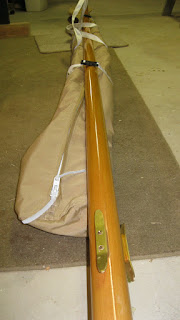
Drop in Sail rig, ready to go with custom canvas sailbag.


Yawldory Elyssa just launched. We built the masts and spars.


Caledonia Yawl birdsmouth-hollow mast designed by Clint (giving the evil eye above) and built in-house by Steven Bauer and the CY owner.

One of our favorite projects is making birdsmouth-hollow masts and spars, but even more rewarding is working with great sailmakers who specialize in small boat sails. We work with them to have the sails made to fit the spars and lace them, make the lines, attach blocks and hardware so that someone can get a complete, drop-in rig from us and go sailing. It is very rewarding. Just delivered was a complete sail rig in a custom canvas sail bag by Mobile Marine Canvas. Just launched was a wicked-light set of masts and spars for the Yawldory Elyssa by Roger Long. The first sea trial was very successful. The masts are spruce made with the birdsmouth construction. Being finished right now in the shop is a new design for a hollow mast for the Caledonia Yawl. We have modified the original mast drawn by Iain Oughtred to be lighter and stronger for Birdsmouth construction. The tolerances involved are a little finer than working with solid masts, because the stiffness and strength of the mast will be a function of overall diameter, wall thickness, and wood type. All these factors, including the on-water use of the mast/spar, are considered when we design and build a mast. The important thing is that the load in the boat is what will exert the stresses on the mast. This load comes primarily from the weight, heeling moment, and crew of a small boat, more so than the wind strength.
Read More..

Kamis, 10 Maret 2016

Rig 6 from 100 Small Boat Rigs 103 Sailing Rigs

One of my boys built himself a lapstrake (clinker) dinghy. At the time, we were working very long hours in the Brisbane workshop and I couldnt give him much of my time to help. But, he was surrounded by timber, glue, and tools, and with space in one corner and a ready-built strong-back he was on his way.

The boat turned out very well indeed, especially as the builder was only fourteen years old.

The owner-builder (Dave, in white) with Cousin Kevin lending a helping hand.
Hull nearing completion
After the building process, Dave was keen to get on the water, and he decided to purchase a carbon windsurfer mast to speed the launching, and a friend gave him an old Laser sail, which happened to be the same size as the designed sail.

Builder, carbon windsurfer mast, and Laser sail
The boat sailed reasonably well with the windsurfer mast, but it was too flexible down low and when sheeted on, the whole rig bent aft inducing weatherhelm and other handling problems - still it was fun.

Sailing nicely in light conditions...

...but in the gusts and sheeted hard, the rig bends aft, and you can see that the boat is becoming difficult to control
Eventually, Dave stashed away enough money to get the proper sail made. It had a fair amount of roach and leech battens which were too short. The leech would not stand as the flexible mast bent back, and it flapped uselessly. I dont have a photo to hand, but below is one of a boat we built earlier to the same design. This one had a nice, hollow timber mast which I made using the "Birds Mouth" method. Although a lot stiffer than the windsurfer mast, the leech problem is still evident.

Stiff mast on an earlier boat, but still having problems with the floppy leech
We decided to do something drastic, so we cut the roach off Daves new sail, removed the battens, and sewed on a new leech tabling (hem, I guess you would call it). This improved the set of the sail, as I had put a slight hollow in the leech and it worked well without battens. But the mast was still too whippy.

The final stage was to install a forestay and two shrouds (side stays). In order to retain the sail-shaping advantages of the bendy mast, we attached the stays at a point only a fraction above the half-height point on the mast (as per Rig 6 in Phil Bolgers book, "100 Small Boat Rigs", which is now published as "103 Sailing Rigs").

The improvement has been astounding. The handling issues have been resolved, and with the mast held at the half-height position, all sorts of sail shaping options are available by using the main sheet, the vang, the halyard, and the outhaul. We made the stays from 4mm Dyneema without an outer sheath as an experiment, and it has worked very well indeed. I couldnt work out the correct method for splicing the braided Dyneema core, so we ended up just doing plain bowline knots around the stainless thimbles - not very neat, but they work fine. I dont have sailing photos, but here is the boat on dry land as we set up the stays.

Stays attached halfway up the mast
Simple lashings
Mast far better controlled, and showing a little 11sq.ft. Heron jib set as well. The original boat carried quite a lot of weather helm and the jib helps to balance that out.
Sail plan in cat-rig form. The alloy sleeve around the lower part of the mast was an earlier attempt to stiffen things up.
All of this shows how much fun you can have messing around with rigs and layouts. A great source of satisfaction.
Read More..

Senin, 22 Februari 2016

Up Date Rig 6 from 100 Small Boat Rigs 103 Sailing Rigs

UP_DATE

Back in early April I wrote an entry about the above rig. You can find the article here http://rosslillistonewoodenboat.blogspot.com/2011/04/rig-6-from-100-small-boat-rigs-103.html

At the time I wrote the piece I didnt have any sailing pictures showing the modified rig in action. Now I can show you a couple. They are low-resolution, but they give a good idea of how much the rig has been improved.

The mast used to bend back alarmingly when sheet and vang were tensioned - now everything stays where it should be and the boats behaviour has been improved dramatically.
Setting out for a day of pleasant sailing with a vastly improved rig
Read More..

Minggu, 07 Februari 2016

Some cat rigs with a French flavor

A good way to spend a day out on the water, politicians in France unanimously doing the right thing (think about that for a minute), and just in case you have not been paying attention...

Over at Voiles Alternative theres a great discussion of the fabled "Punch" catboats from the design office of Phillipe Harle that you might want to check out.

Listening to Ingrid Michaelson

So it goes...

Read More..