Ive written before about Canoe Yawls here and here . There is something about the elegant simplicity and sense of independence which exerts a very powerful grip, although Im beginning to wonder whether pure romanticism is the real driver
 |
| A George Holmes sketch of Ethel and Nan in Denmark in 1886. (Sail and Oar) John Leather |
My brain seems to be particularly subject to distractions, and I find myself repeatedly going off on boat-related tangents which follow a predictable, if meandering, course. My latest one was started when I re-read some sections of L. Francis Herreshoffs superb book,
The Common Sense of Yacht Design, in search of a particular bit of technical data. Something in the book about the optimum forefoot shape for a sailing boat lead me eventually back to Albert Stranges beautiful
Wenda design, a longtime favourite of mine
 |
| Albert Strange Wenda (forum.woodenboat.com) |
 |
| A photo of Wenda s beautiful stern. This example was built for Dick Wynne by boatbuilder Fabian Bush. |
 |
| Another view of Wenda. www.fabianbush.com |
Being on a roll (once again) about canoe yawls, I got talking with my boating friend, Ian Hamilton, in the hope that he would get swept up in the process also. Ian had for years been smitten by another of Albert Stranges designs - in this case the designers own favourite,
Cherub II, so I expected his full support. Strangely he was ambivalent, saying that he had come to realise over the years, that the canoe yawls which appealed to us so much were "...cold water boats...".
 |
| Albert Stranges personal favourite, Cherub II (Sail and Oar by John Leather) |
 |
| Cherub II - Lines and General Arrangement (Sail and Oar by John Leather) |
Over the last week or so Ive been pondering Ians comment about the canoe yawls being "...cold water boats..." and Im not sure I agree with him. However, it did stop me from marching off blindly on another enthusiasm, and gave me pause for thought.
What it comes down to is that the
activity and the
boats change depending on geographical location, but the
philosophy remains unchanged.
 |
| A William Garden-designed Eel, complete with hinged cuddy-cabin top just like the canoe yawls of the late 1800s. This particular example was built glued-lapstrake, with epoxy-bonded marine plywood planking. She is a very "open" sort of boat, but I think she would look at home on just about any coastal waterway. |
 |
| Two pictures of my Little Egret design, which would make an excellent "warm and shallow water" canoe yawl. Remember, canoe yawls are not necessarily canoes, and arent always rigged as yawls. The name relates to boats which evolved from canoes, some of which resembled ships yawl boats. |
Around the time that I was in full canoe yawl swing, one of my sons was beginning to make repeated comments about setting up a syndicate and having me build a Phil Bolger-designed
Black Skimmer for use on Moreton Bay and the Great Sandy Straits (Queensland, Australia).
Black Skimmer is a 25ft 3in x 7ft x 10in cat yawl-rigged leeboard sharpie built from plywood and epoxy.
 |
| Tashtego, a beautiful example of Phil Bolgers Black Skimmer-design, built around 1980 by Walter Baron of Old Wharf Dory Co. www.oldwharf.com |
I had been putting son David off about a
Black Skimmer, on the basis that we couldnt justify a boat of that size. But with my new attitude towards the sorts of boats suited to the canoe yawl function in our part of the word (hot, and lots of shallow water), and given the possibility of a family syndicate to spread costs and maybe keep the boat in the one family for generations, excitement started to build.
Black Skimmer (plans here) has been my dreamboat (along with
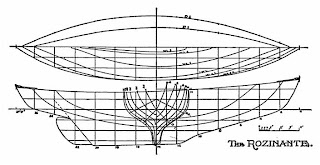
Rozinante) for the last 33 years. But in the last decade or so, Ive been preaching the "small boats get used more" line so strongly that I had just about convinced myself that my dreamboats were off the agenda. I hadnt considered the enthusiasm, optimism, and idealism of youth ever coming back to me, but I hadnt counted on the advantage of having kids!
So, what is special about
Black Skimmer? Here is a partial list: -
- shoal draft - 10 or 11 inches/ 279mm;
- free-standing rig with masts which do not pierce the watertight volume and can be raised and lowered without a crane;
- self-vanging sails (due to the sprit booms);
- self-righting with a self-draining cockpit;
- effective watertight ventilation arrangement;
- leeboards and the resultant open interior and strong bottom;
- simple, but well engineered, structure;
- self-draining well forward (for anchor, chain, mud, and sail handling;
- self-draining well aft for outboard, fuel, anchor, mud, and crabs;
- wonderful sprawling space in a cabin arranged with a raised deck. This is a strong, easily-built cabin-structure, and it provides important reserve buoyancy in the event of a knock-down;
- sitting headroom in the cabin;
- proven performance.
Having said all that, I am still haunted by the vision of a beautiful double-ended canoe yawl like Wenda or Rozinante. Just today I was contacted by an exceptionally knowledgable and experienced friend who told me that I had only one life, and that if I didnt build a Rozinante I would go to my grave a lesser man.




.jpg)

